
What Does Chevy Blue Engine Paint Mean?
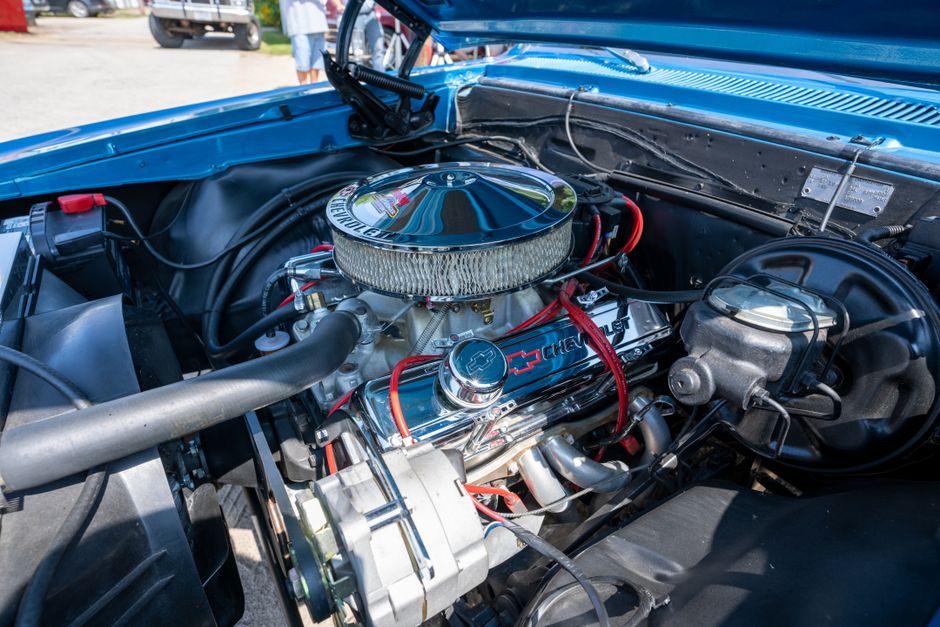
“Chevy blue” can mean Chevrolet Blue or GM Corporate Blue, but the names refer to distinct catalog colors. Dupli-Color lists DE1609 as Chevrolet Blue and DE1608 as GM Blue; late-1970s and early-1980s listings support corporate blue for some engines, not every model. Match paint to the exact engine and year, then account for age, heat exposure, and the paint brand.
Is Chevy Blue the same as GM Corporate Blue?
No. “Chevy blue” is often used loosely, while paint catalogs separate Chevrolet Blue from GM Blue or GM Corporate Blue. Dupli-Color identifies DE1608 as gloss GM Blue and DE1609 as gloss Chevrolet Blue. They are separate catalog colors, not interchangeable product names.
The naming matters when restoring an engine. A listing for “corporate blue” does not automatically identify Chevrolet Blue, and a color described informally as Chevy blue does not establish the correct paint code. Check the label and intended application rather than choosing by a broad color name.
The engine-color reference at Pontiac Power lists GM Corporate Blue for 1977–1982 engines and identifies DE1608 as General Motors Blue. That overlaps with Dupli-Color’s DE1608 naming, but does not erase the distinction between DE1608 and DE1609. Catalog names and application fitment are more useful than a general description of the color.
Which paint is right for a 1978–1982 Chevy engine: DE1608 or DE1609?
For many 1978–1982 small-block Chevrolet applications, GM Corporate Blue is the supported direction, which points toward a GM Blue product such as DE1608 rather than assuming DE1609 is the same shade. YEARONE describes its GM Corporate Blue paint as intended for 1978–1982 small-block Chevy engines. Confirm the exact engine and vehicle before buying.
Catalog fitment supports a range; it does not prove that every engine in every model used one paint. National Parts Depot lists GM Corporate Blue applications across several vehicle lines for model years 1978–1981, including Camaro, Chevelle/El Camino/Malibu, Firebird, Chevy truck, K5 Blazer, and Monte Carlo. Its listings are application-specific. Use the vehicle and engine details to narrow the choice.
| Paint or reference | What the source identifies | How to use the information |
|---|---|---|
| Dupli-Color DE1608 | Gloss GM Blue | Compare against GM Corporate Blue application listings. |
| Dupli-Color DE1609 | Gloss Chevrolet Blue | Treat as a distinct catalog color; do not substitute by name alone. |
| YEARONE Corporate Blue | For 1978–1982 small-block Chevy engines | Check whether the vehicle and engine match the listing. |
For an engine at the edge of a year range, production timing can matter. Pontiac Power reports that the Flint engine plant changed Chevrolet engine paint from orange to blue between August 23 and September 7, 1976, with different engine lines changing on different dates. Early 1977-model production could therefore vary. Model year alone may not settle the question.
What years used Chevrolet Blue engine paint?
There is no single year range in these sources that establishes Chevrolet Blue as the right paint for every Chevy engine. The references support GM Corporate Blue for a number of 1977–1982 engine or vehicle applications, with differences in scope and coverage. They do not establish one universal Chevrolet Blue schedule across all models and engine configurations.
Use a short verification sequence before repainting. First, identify the engine and vehicle model year rather than relying on the car’s general era. Second, compare the exact application against a restoration-parts listing such as YEARONE or National Parts Depot. Third, look for protected original paint on the engine and compare that evidence with the catalog color; exposed surfaces can no longer be assumed to show the original shade accurately.
Age and heat cycles complicate the comparison. Pontiac Power cautions that aftermarket shades may differ from factory paint. A faded or heat-exposed engine surface and a fresh can of enamel can look different even when both are described with the same general color name. A catalog match is a starting point, not proof that a weathered surface should match the new paint exactly.
Dupli-Color rates its engine enamel for intermittent temperatures up to 500°F and lists engine blocks and accessories among its intended uses, including air cleaners, oil pans, valve covers, and intake manifolds. Its instructions call for cleaning and scuffing the surface, then applying two light coats followed by one medium wet coat. The stated coverage is 12–15 square feet per 12-ounce can. Follow the product directions for the surface and application rather than treating the temperature rating as a substitute for preparation.
The same product can serve the block and listed accessories, but that does not show that all parts originally carried identical paint. Confirm the original shade and finish for the specific component when that distinction matters. For unrelated paint work, see How Do I Choose a Reputable Detailer for Paint Correction and Ceramic Coating?
Frequently Asked Questions
What is the difference between Dupli-Color DE1608 and DE1609?
Dupli-Color catalogs DE1608 as gloss GM Blue and DE1609 as gloss Chevrolet Blue. They are separate catalog colors, so treat them as distinct choices when matching an engine.
Why does old Chevy engine paint look more teal or faded?
Age and heat cycles can change the appearance of paint, and the engine-color reference notes that aftermarket shades may differ from original factory paint. Aged paint therefore does not provide a reliable direct match to a new can.
Does the engine block and its accessories use the same blue paint?
Dupli-Color says its engine enamel is intended for blocks and accessories such as air cleaners, oil pans, valve covers, and intake manifolds. That describes the product’s intended uses, not proof that every component on every vehicle originally shared one shade.
Sources
You may also like

How Do I Choose a Reputable Detailer for Paint Correction and Ceramic Coating?
A practical checklist for comparing paint-correction and ceramic-coating detailers, quotes, guarantees, and preparation standards.
Should I Repair, Rebuild, Replace, or Replace My High-Mileage Car?
A practical framework for comparing engine repair, replacement, rebuild, and vehicle replacement costs before you authorize work.

Costco E-Bike Clearance: Check the Deal Before You Buy
Check local stock, fit, returns, battery support, and bike-shop service before treating a Costco e-bike clearance price as a bargain.